Babelian language in Finnegans Wake
Finnegans WakeBabelian language in Finnegans Wake turns linguistic mixture into a governing principle of the novel. Words absorb sounds and meanings from multiple languages and social registers, while spelling, punctuation, and even the physical condition of writing complicate the search for a single authoritative account. The result is not noise opposed to meaning but a restless, communal language in which meanings recur, shift, and contend.
A Babel of voices and registers
The book stages linguistic mixture through voices that move rapidly among public speech, legal allegation, popular song, gossip, religious language, and comic performance. In the account of the park encounter, a stranger accosts HCE with a garbled question about the time and Guinness; HCE answers by consulting his watch and reporting the hour. The exchange then turns toward the accusation against him, recast through layered and unstable reports. Everyday speech, public scandal, and quasi-legal testimony occupy the same verbal space, so that no one register can simply certify what happened.
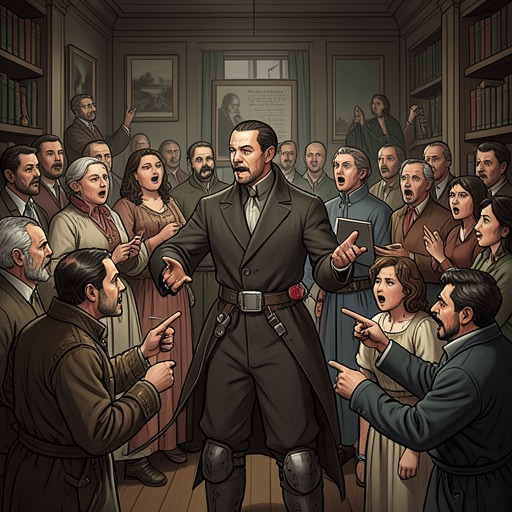
The song made by Hosty converts that instability into a public chorus. It offers a string of competing names for the accused figure before settling, provisionally, on Persse O'Reilly; the refrain repeatedly hands authority back to Hosty as the man who can rhyme the song. The performance is explicitly collective, with spoken, solo, and answering voices, and ends in a crash of broken glass. Language here does not just describe public reputation: it creates and circulates it, while the shifting names show how easily a person becomes a communal verbal construction.
Other passages imitate the idioms of witnesses and commentators without allowing their accounts to cohere. A dustman, a cabdriver, a barmaid, a detective, and other observers deliver sharply different judgments about HCE, moving between mock testimony, legal language, and street talk. Their statements are not neutral windows onto a settled case; each arrives in a distinct verbal costume, and the reader must confront the distance between a claim and the authority its speaker appears to possess. The question of whether reported outrages are fact or fabrication remains entangled with the language that reports them.
Writing as an unstable object
The novel makes its verbal plurality visible in the document itself. It describes the “proteiform graph” as a polyhedron of scripture, a figure for a text that can be approached from multiple directions and cannot be reduced to one transparent account. The writing seems to bear traces of several personalities and possible crimes, yet those contrarieties can coalesce into one elusive somebody. Rather than presenting a clean original behind its variations, the text makes multiplicity part of what the reader encounters.
The account of the document’s layout treats its lines as directional barriers: they run north-south and west-east, cross one another, and make the page a space to be traversed. Writing is compared to turning and returning, with lines and letters seeming to move in different directions. Its material history also matters: the document has accumulated stains and other traces during its passage through time. Reading therefore involves not only interpreting words but also imagining how marks, surfaces, and successive handling have shaped the evidence.
A further account inventories the document’s irregularities: blocked or incomplete circles, initials associated with Earwicker, shifting marks, underlinings, variant spellings, marginal signs, and apparent omissions. Some signs invite more than one direction of reading; a warning mark before words allows them to be taken in any order. The script’s gaps and alterations do not simply conceal a recoverable message. They make the act of ordering, connecting, and revising part of the text’s meaning.
Sound, recurrence, and interpretation
The novel repeatedly makes words behave as sound before they settle as sense. In a passage that turns around Babel, a speaker declares, “And shall not Babel be with Lebab?” The reversal of Babel into Lebab makes linguistic transformation itself audible, while the surrounding speech expands through altered names, repeated sounds, and invented verbal compounds. The scene’s thunderous language is presented as a force that reaches across the world and makes its inhabitants tremble: sound is both a physical-seeming event and an unstable vehicle of interpretation.
Elsewhere, the text links sound and word directly, describing a moment when “Where flash becomes word and silents selfloud.” The phrase makes language a conversion between perceptible event and verbal form, while the surrounding passage draws on signals, colors, movement, and syllables. A name or utterance can therefore feel at once spoken, seen, and transmitted; the text keeps shifting the boundary between language and the other forms through which people register the world.
This linguistic motion connects Babelian language to the novel’s wider recurrences and transformations. A passage at the opening of a new episode reflects on Finn, the bride’s view of a man “that means a mountain,” and the glory of a wake, setting personal and collective meanings against one another in a circling verbal movement. Later, a compact sequence places desire and despair, beauty and grief, side by side, then describes a return to baseness despite grand remonstrance. Such pairings do not resolve into a single explanatory formula; their oppositions remain active in the language itself.
Meaning without a final key
Babelian language makes reading resemble reconstruction rather than straightforward decoding. The text’s mixtures and distortions allow a phrase to carry multiple associations at once, while changes in spelling, voice, or punctuation alter what seems to be said and who can claim to have said it. The reader is not offered a stable transcript that would dissolve the novel’s conflicts; even a document that appears to preserve evidence bears signs of damage, revision, and competing interpretations.
That uncertainty is also a social fact within the novel. Public opinion, song, testimony, and official-sounding discourse all participate in forming the story of HCE, but their verbal fluency does not guarantee truth. The Babelian method exposes how accounts are made and passed along: voices borrow from one another, reputations acquire new names, and a crowd’s refrain can sound authoritative without ending disagreement. Linguistic multiplicity is thus both the novel’s formal engine and a way of representing a world in which history and identity remain disputed.